

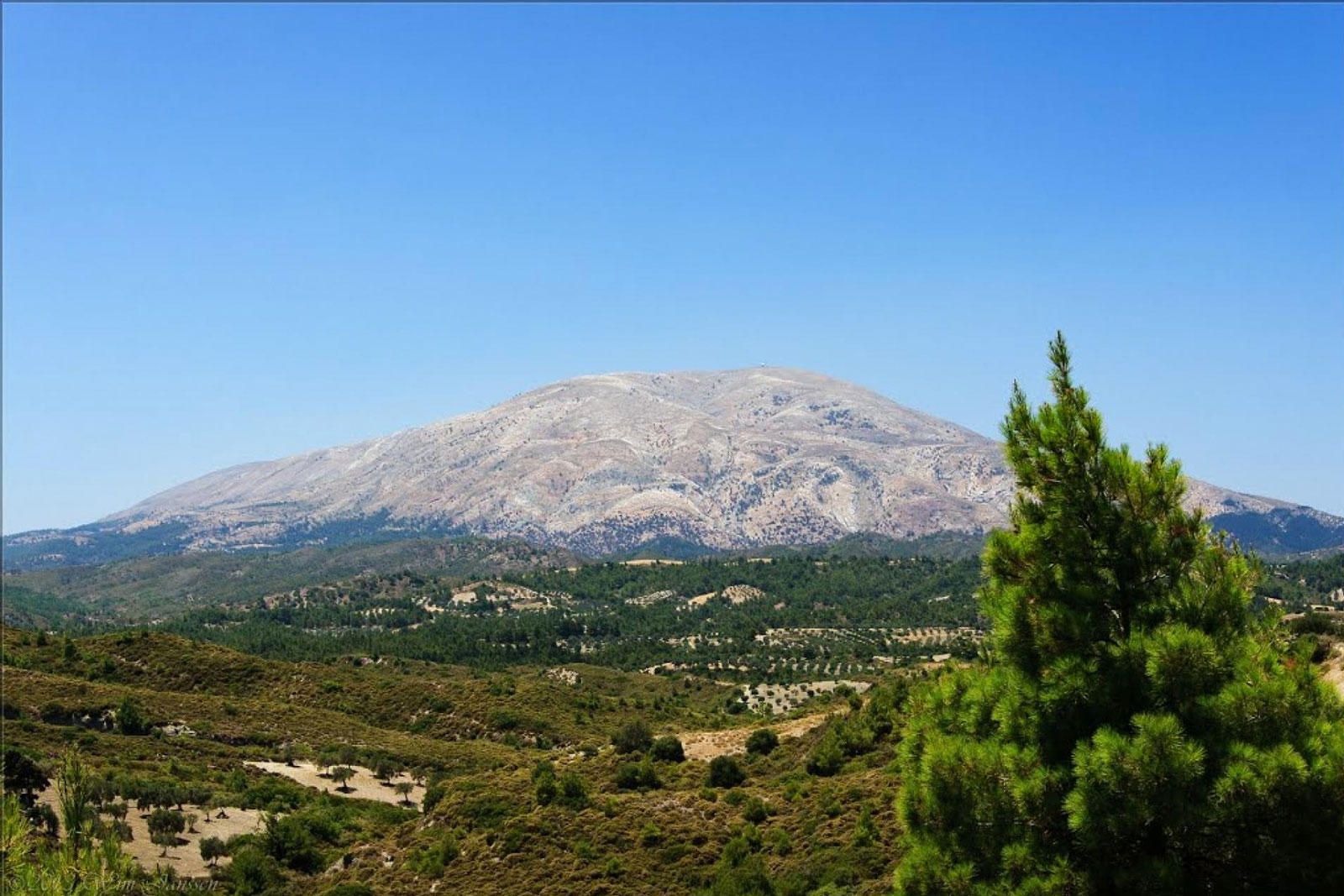
Standing on the Roof of the Dodecanese
Rising majestically in the southern center of the island, Mount Attavyros (1,215 meters / 3,986 feet) dominates the horizon of Rhodes. While the coastal plains remain warm and humid throughout the year, Attavyros is a wild, austere kingdom of windswept grey limestone, ancient myth, and staggering panoramic vistas.
From the summit, on a crisp morning, the entire Aegean unfolds before your eyes. You can see the full outline of Rhodes stretching from the northern tip near Mandraki Harbor down to the southern windswept cape of Prasonisi. Across the glistening blue waters, the neighboring islands of Chalki, Symi, Tilos, and even distant Karpathos rise against the horizon, alongside the rugged mountain chains of the Turkish coastline.
Mythology: The Sanctuary of Zeus and the Cretan Exile
In Greek mythology, Mount Attavyros holds a sacred and tragic place. According to ancient lore, Althaemenes, grandson of King Minos of Crete, learned of a terrifying prophecy that he was fated to kill his own father, Catreus. Desperate to escape this dark destiny, Althaemenes fled his native Crete and sailed to Rhodes.
Upon arriving, he climbed to the summit of the island’s tallest mountain. Looking southwest across the sparkling sea, he discovered that Attavyros was the only spot in Rhodes from which his beloved homeland of Crete remained visible on the distant horizon.
In honor of the supreme Olympian deity, he established the Sanctuary of Zeus Attavyrios. Excavations by archaeologists have uncovered bronze votive statues of sacred bulls, pottery, and ceremonial hearths dating back to the Mycenaean era and the 6th century BC. Standing among the ancient stone ruins on the windswept summit, you can still feel the profound spiritual gravity of this ancient mountaintop shrine.
The Hiking Route: The Ascent from Agios Isidoros
For passionate mountaineers and hikers, ascending Attavyros on foot is the premier trekking challenge in Rhodes:
– Starting Point: The tranquil mountain village of Agios Isidoros on the southern foothills.
– Trail Characteristics: The ascent follows a steep, direct path marked by red paint splashes on the rocks. There is little tree cover after the first 30 minutes; the landscape quickly shifts from olive terraces to rugged grey limestone scree.
– Trail Duration: 2.5 to 3.5 hours for the ascent, and 2 hours for the descent. The elevation gain is roughly 900 vertical meters.
– Key Advice: Start at dawn during summer (before 7:00 AM) to avoid scorching midday sun, carry a minimum of 2.5 liters of water per person, and wear rigid hiking boots with solid ankle support.
The 4×4 Off-Road Ascent: Thrills and Untamed Scenery
For those who wish to experience the majesty of Attavyros without a grueling 5-hour vertical hike, an off-road 4WD vehicle provides the ultimate alternative. A rugged unpaved track winds its way up the mountain’s flanks, traversing rocky switchbacks, wild herb-scented plateaus, and dramatic drop-offs that standard rental cars cannot possibly navigate.
At Rhodes Adventures, our custom 4×4 safaris frequently incorporate the foothills and high ridges surrounding Attavyros and the neighboring wine village of Embonas, allowing drivers to experience the sheer scale of the mountain while staying safe in a guided convoy.
Embonas Village: The Perfect Post-Climb Wine & Grill Stop
No expedition to Mount Attavyros is complete without descending to Embonas, the wine capital of Rhodes nestled directly on the mountain’s northwestern slopes. Because the vineyards of Embonas grow on high-altitude limestone slopes cooled by mountain breezes, they produce the island’s most celebrated grapes – notably the crisp white Athiri and full-bodied red Amorgiano.
After the dust and wind of the summit, pulling into a traditional rustic tavern in Embonas to feast on grilled local lamb chops (paidakia), wild mountain greens (chorta), and a glass of chilled local wine is the ultimate reward.
Winter Wonders: Snow on a Greek Island
While international tourists associate Rhodes exclusively with summer beach holidays, locals know that Attavyros shows a breathtakingly different face in the heart of winter. In January and February, powerful Aegean weather fronts regularly deposit pristine white snow blankets across the peak.
Witnessing snowdrifts glistening on ancient limestone ruins while gazing down upon palm trees and blue Mediterranean water along the coast is an astonishing contrast that very few foreign travelers ever get to witness.