

A Mountain Steeped in Myth, Knights, and Nature
Rising like a green emerald above the shimmering northwestern shores of Rhodes, Mount Filerimos (267 meters) is one of the most culturally layered and visually captivating peaks in the Mediterranean. Long before the Knights of Saint John constructed their fortified monastery here, this hill served as the ancient acropolis of Ialysos – one of the three founding Doric city-states of Rhodes dating back to the 8th century BC.
While most tourists take an air-conditioned taxi or rental car up the curving paved switchbacks, true adventurers know that the best way to experience Filerimos is on foot, winding through peaceful pine forests that feel a world away from the busy beaches of Ialysos and Trianda.
The Forest Trail: Firefighter Paths and Scented Pine Canopies
Our guided hiking route avoids the vehicle tarmac entirely. Starting from the tranquil foothills, we follow historic dirt tracks initially carved decades ago by the local forestry department to provide emergency access across the mountain’s dense woodland.
As you ascend, the noise of coastal resorts fades, replaced by the gentle crunch of pine needles beneath your hiking boots, the rhythmic hum of cicadas, and the fresh scent of wild sage, myrtle, and resin. The trail climbs at a comfortable, gradual gradient that allows you to absorb the landscape without exhausting your endurance.
Along the shaded forest ascent, your guide will point out botanical treasures: native Rhodian orchids in spring, aromatic mountain herbs used in traditional herbal teas, and ancient stone wells where passing shepherds and pilgrims refreshed themselves centuries ago.
Meeting the Famous Peacocks of Filerimos
As you approach the summit plateau, a chorus of distinct, echoing calls announces the mountain’s most celebrated permanent residents: the majestic peacocks of Filerimos.
Originally introduced to the monastery gardens by Italian monks in the early 20th century, these regal birds have flourished in the pine forests for generations. Today, dozens of free-roaming peacocks strut proudly across stone walls, perch in high cypress branches, and fan their iridescent emerald-and-sapphire tail feathers for delighted photographers. They are remarkably calm around hikers, allowing you to capture breathtaking close-up wildlife portraits.
The Avenue of Golgotha and the Iconic Cross
At the summit lies the famous Golgotha walkway – a dramatic stone pathway sheltered beneath a cathedral of towering cypress trees. Flanking the path are bronze and stone relief shrines depicting the fourteen Stations of the Cross, commemorating Christ’s path to Calvary.
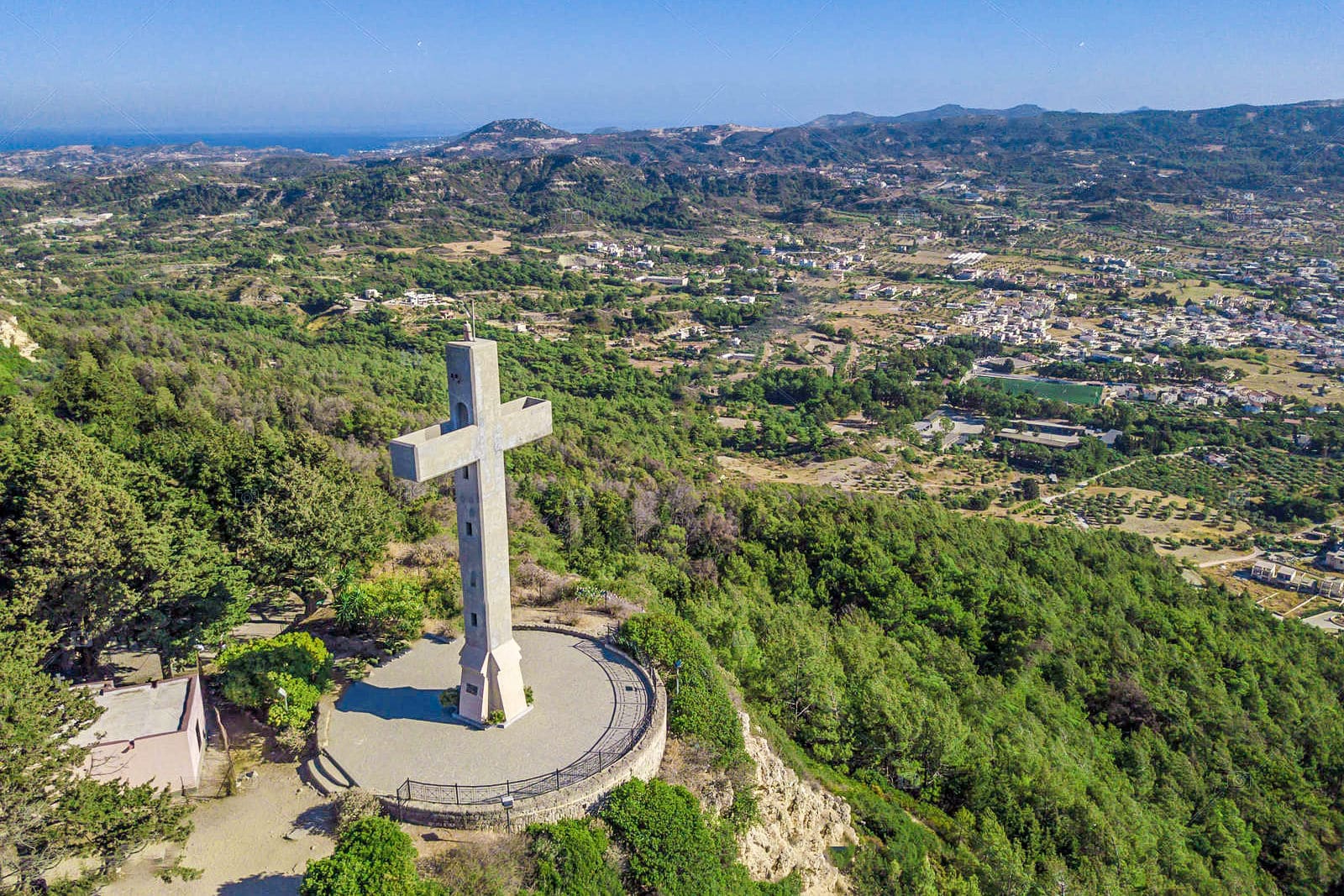
At the western terminus of this peaceful avenue stands the monumental Cross of Filerimos. Towering 18 meters high, this reinforced concrete structure is visible from miles out at sea. When conditions allow, visitors can ascend the narrow spiral staircase inside the cross to emerge onto its horizontal viewing arms.
The panorama from this vantage point is staggering: looking west, you gaze down upon the sapphire expanse of the Aegean Sea, the runway of Diagoras International Airport where passenger jets look like miniature toys, and on clear days, the misty volcanic outline of nearby islands such as Symi, Nisyros, and the mountainous coastline of Asia Minor.
The Medieval Monastery of Our Lady of Filerimos
Adjacent to the plateau stands the restored 14th-century monastery built by the Knights Hospitaller of Saint John over the ruins of an ancient temple dedicated to Athena Polias. The complex features a rare four-chapel design, subterranean crypts with surviving Byzantine wall frescoes, and peaceful cloistered courtyards overflowing with bougainvillea.
Before beginning the scenic descent down the mountain’s southern face, we pause under the shade of ancient olive trees for a traditional hiker’s picnic featuring crusty bread, local feta, ripe village olives, and fresh fruit.
The Ancient Doric Fountain of Ialysos
On our descent along the southern slopes, the trail leads hikers past one of the hidden archaeological treasures of the mountain: the 4th-century BC Doric Fountain of Ialysos.
Carved directly into the limestone rock face, this ancient water reservoir provided life-giving fresh spring water to the citizens and soldiers of ancient Ialysos over 2,400 years ago. Its classical stone portico, water basins, and Doric columns remain evocative reminders of the deep classical roots anchoring every stone of this mountain.